Maryland Contributory
Negligence Lawyer
If you were injured due to another person’s careless actions, our Maryland contributory negligence lawyers can help you preserve your right to fair compensation. State law can make it more challenging to obtain damages if the insurance company tries to shift blame onto you, but we know how to challenge those tactics.

Legally Reviewed By:
Adam M. Smallow
May 15, 2026
Maryland’s contributory negligence law can prevent you from recovering compensation if you’re partially at fault for the accident that caused you harm. Your case requires a comprehensive strategy to prove that you were not responsible for your injuries, but this can be challenging to achieve on your own.
Adam Smallow Injury Lawyers is here to help you fight for the financial recovery you deserve. Call us today at (410) 449-7900 for a free consultation about your case with a trusted member of our team.
Navigate This Page
- What Is Contributory Negligence?
- If I Was Injured in Maryland, How Do Contributory Negligence Laws Affect Me?
- How Our Maryland Contributory Negligence Attorneys Can Help You Pursue Compensation
- What Types of Personal Injury Cases Are Subject to Contributory Negligence Laws?
- What Are Some Exceptions Where Contributory Negligence Laws Do Not Apply?
- Notable Contributory Negligence Cases and Ongoing Legal Criticism
- Adam Smallow Injury Lawyers Can Help You Pursue Your Contributory Negligence Case in Maryland
- Contributory Negligence FAQs
What Is Contributory Negligence?
Contributory negligence is a legal principle that prevents an injured person from recovering damages if their actions or failure to act contributed in any way to the accident that caused their injuries. Even if they’re as little as 1% at fault, they may be ineligible for any compensation under Maryland’s definition of contributory negligence. Maryland is one of only four states, alongside Virginia, North Carolina, and Alabama, that follow this rule.
Situations Where Contributory Negligence May Apply
Many types of personal injury scenarios can involve contributory negligence, including:
- Driving slightly over the speed limit at the time of a collision
- Looking down at your phone while walking through a parking lot and failing to notice an approaching vehicle before being struck
- Wearing shoes with little traction and slipping on a wet surface in a store
- Using a poorly maintained staircase without holding the handrail and then losing your balance
- Failing to check your blind spot a second time before changing lanes and sideswiping a speeding vehicle
- Wearing headphones at high volume while crossing a street and failing to hear an approaching vehicle
If I Was Injured in Maryland, How Do Contributory Negligence Laws Affect Me?
How contributory negligence laws affect plaintiffs varies on how they were injured and what factors caused the accident that led to their injuries. The only blanket statement that can be made is that if you are found partially at fault for the accident, you may not collect damages for your injuries due to contributory negligence. However, that does not mean that any suspicion of fault on your side equates to contributory negligence.
When the Defendant Claims Contributory Negligence
After a plaintiff files a personal injury lawsuit against a potentially liable party, that party can review the case and determine whether they have grounds to deny your claim under contributory negligence. Defendants do not have an automatic right to claim contributory negligence as an attempt to avoid paying damages to the plaintiff.
To claim contributory negligence in Maryland, the defendant must be able to prove:
- The plaintiff had an assumption of risk: The defendant must prove that the plaintiff knew about the hazard and the risks it posed before getting injured. For example, drivers who speed on the road know they risk getting into a collision with people who pull out in front of them suddenly.
- The plaintiff contributed to the cause of the accident: The defendant must prove that the plaintiff’s actions or inactions also played a factor in how the accident occurred. For example, drivers who make an improper turn and then get hit from behind or the side might be held partially at fault for turning without signaling or when they did not have the right of way.
- The plaintiff could have avoided the accident if they practiced more care: If the defendant is found at fault for breaching their duty of care and the defendant can prove that the plaintiff also had a duty of care that they breached, they may claim contributory negligence. For example, all drivers have a duty of care to uphold on the road, including the plaintiff.
A personal injury lawyer can help fight for your case to not be affected by contributory negligence. Even if you think your case is foolproof or that it is seemingly obvious that the other party is at fault, our personal injury lawyers have handled various cases that have brought on their own surprises. We aim to be thorough when analyzing your case so that we can consider as many potential counterarguments as possible that the defendant’s attorney(s) or the insurance adjusters might bring.
Call the Adam Smallow Injury Lawyers for a free case evaluation at (410) 449-7900. We can begin setting up your client file and strategize how to build your case. Call today.
Get on the road to recovery with competent legal representation and high-quality medical professionals. Contact our Maryland personal injury lawyer today.
How Our Maryland Contributory Negligence Attorneys Can Help You Pursue Compensation
Maryland’s contributory negligence law can bring down even the strongest personal injury cases. Having the right legal representation can make a powerful difference when insurers try to use this law to their advantage. Our Maryland car accident lawyers can help you fight for compensation by:
- Identifying and addressing weak points in your claim before the defense raises them
- Investigating the accident to determine exactly what contributed to your injuries and who’s at fault
- Gathering evidence to counter claims that you’re partially at fault
- Handling communications with insurance adjusters to prevent them from using your words against you
- Negotiating for a fair settlement that reflects the full impact of your injuries
- Filing a lawsuit and representing you in trial if the insurer continues to argue contributory negligence
With over a decade of experience handling many kinds of personal injury cases in Maryland, Adam Smallow has the insight necessary to strategize how your case might go in court or negotiations. If he and his team can collect enough evidence to support your case and prove that you played no role in the cause of your accident, it may be possible to compel the at-fault party to cover your damages.
“Amazing Attorney. We found him through a friend. Attorney Smallow and his employees were always available to address our concerns. They got me and my wife the best medical care that we needed to overcome our injuries due to a motor vehicle accident. And we received a fair settlement for our injuries and suffering. He is an honest and compassionate gentleman.”
“The moment I called into Adam Smallow Injury Lawyers, I finally felt at ease with everything I’ve been going through. Losing something you’ve worked so hard for, and to be the one to lose more than the one that hit you and to now deal with uncomfortableness everyday from the injury, can be tough… This process is hard and stressful, but I have a great team behind me. Thank you!”
What Types of Personal Injury Cases Are Subject to Contributory Negligence Laws?
Many negligence-based personal injury claims in Maryland may be affected by contributory negligence laws if the defense can show the plaintiff’s own negligence contributed to the injury. Our attorneys handle a wide range of case types involving this area of Maryland negligence law.
Certain case types, especially car accident and slip and fall claims, more often involve contributory negligence arguments because disputes frequently arise over whether the injured person’s own actions played a role in what happened. By contrast, strict product liability claims are analyzed differently. In those cases, defendants may be more likely to raise defenses such as product misuse or assumption of risk, particularly if the injured person knew about the defect or danger and chose to use the product anyway.
It feels like as a personal lawyer in Maryland, we have one hand tied behind our backs at all times because it’s such a restrictive liability law. In many ways, Maryland’s contributory negligence law has made us a better law firm because we’re prepared for trial for day one. We know all the obstacles. We know the laws. We know the bad faith tactics of the insurance companies. So we just know at the very beginning that we have to have a plan in place to make sure that you get the care you need, and your case is settled for maximum compensation. You can’t wait until the middle, and you certainly can’t wait until the end to decide how you’re going to work these cases in Maryland on behalf of your clients. And a big part of that is the contributory negligence law.
– Adam Smallow, Founding Partner
What Are Some Exceptions Where Contributory Negligence Laws Do Not Apply?
While contributory negligence in Maryland can prevent plaintiffs from collecting damages, this doctrine does not necessarily apply in all cases. According to the American Bar Association (ABA), there may be exceptions to contributory negligence in these situations:
- When the plaintiff is younger than five years of age
- In strict liability cases
- In cases where the last clear chance doctrine applies
The defendant would have to have a strong argument against the plaintiff to have contributory negligence apply in strict liability cases, such as cases involving a defective product or drug, as these cases generally hold more liability on the product manufacturer and seller to keep the public market safe from defective or dangerous products.
Notable Contributory Negligence Cases and Ongoing Legal Criticism
George Poole v. Coakley & Williams Construction, Inc. (2010)
In 2010, George Poole v. Coakley & Williams Construction, Inc. established “assumption of risk” in personal injury cases. In essence, if a defendant can prove that the plaintiff had prior knowledge of the risk of danger for the event or hazard that led to their injury, the plaintiff’s claims for damages may be disputed.
It can be difficult to prove a plaintiff’s assumption of risk, as evidence must be undisputed and based on fact, not the assumption that all people “should” have the same level of risk understanding. The defendant must prove that the plaintiff either had previous experience with the hazard or that the hazard was obvious enough to alert danger.
Coleman v. Soccer Association of Columbia (2013)
In 2013, James K. Coleman filed a personal injury lawsuit against the Soccer Association of Columbia after having a goal post fall on him, causing several facial fractures.
In the case Coleman v. Soccer Association of Columbia, the jury confirmed that the association was negligent for not anchoring the goal post. However, they also asserted that because Coleman, who was a volunteer soccer coach at the time, did not inspect to see if the goal was anchored before jumping up and grabbing the crossbar, he was also partially negligent for his injuries.
This case determined that contributory negligence was still a viable defense for defendants to use and is often sourced as the main reason Maryland still upholds the doctrine today.
Criticism of Contributory Negligence
Scholars have criticized the contributory negligence doctrine in Maryland, claiming it gives too much leniency to defendants and absolves them of accountability for plaintiffs’ damages.
In the Maryland Law Review Volume 73, Issue 3, scholars Donald G. Gifford and Christopher J. Robinette wrote an essay arguing that the doctrine should be abolished, noting that the doctrine is an antiquated law introduced in 1847 at the advantage of businesses, not the plaintiffs. Instead, they argue that comparative negligence should be adopted and that even one of the most business-friendly states (Delaware) also abides by comparative law.
Adam Smallow Injury Lawyers Can Help You Pursue Your Contributory Negligence Case in Maryland
When a defendant counterclaims with contributory negligence, it can raise the stakes on your case. Our attorneys are here to help you build a comprehensive case and push back against unfair claims about your role in the accident.
When you choose our Maryland contributory negligence lawyers to represent you, we’ll focus on the legal details while you focus on healing. As we develop your case, you’ll have access to our robust network of medical providers, regardless of your insurance status. Our team will stay in close contact, providing 24/7 access via phone or text whenever you need quick answers about where you stand.
Let us take you From Hurt to Help, starting with a free consultation. Contact us online or call (410) 449-7900 to discuss your situation with a trusted member of our team. You pay nothing unless we recover compensation on your behalf, so there’s no risk to pursue a contributory negligence case with our team.
Contributory Negligence FAQs
Learn more about how contributory negligence cases work with our answers to these frequently asked questions.
Why Is It Important To Talk to a Lawyer After an Accident Involving Contributory Negligence?
If the insurance company argues that you’re partially at fault for your accident, you may be unable to recover any compensation under Maryland law. Consulting our lawyers after a car accident allows you to understand whether your case has a chance to withstand the insurer’s contributory negligence claims. If we believe you have a strong case, we can collect evidence that’s often difficult to access on your own, such as witness statements, security or traffic camera footage, or black box data from trucking companies.
How Are Contributory Negligence and Comparative Negligence Different?
The key difference between contributory negligence and comparative negligence is how each approach handles shared fault in a personal injury case. Contributory negligence is more of an all-or-nothing rule that prevents the injured person from recovering compensation if they’re even slightly at fault. In contrast, comparative negligence allows an injured person to recover damages even if partially liable, but their compensation is reduced by their percentage of fault.
What’s the Difference Between General Negligence and Contributory Negligence?
General negligence and contributory negligence differ in which party they focus on. General negligence is an argument aimed at the defendant, whereas contributory negligence is an argument aimed at the injured person. Both can affect whether an injured person receives compensation.
How Is Fault Determined in a Contributory Negligence Case?
In personal injury cases involving possible contributory negligence, fault is determined by examining the circumstances that led to the accident and whether any party could have prevented it. For example, if you were injured in a car accident, our lawyers might consider whether anything you did—such as your speed or attention—could be used to argue that you share even a small degree of fault.

"*" indicates required fields
for a client seriously injured in a high-impact car crash requiring neck surgery.
for a client who required back surgery after a low-impact car accident.
for a client injured in an auto accident where another driver recklessly changed lanes.
Working with Adam Smallow Injury Lawyers was one of the best choices I have made! I can’t recommend this business more. From start to finish my experience with them was nothing but positive. They are very knowledgeable, genuine and caring people that care about their clients. If you’re looking for an injury lawyer, Adam Smallow is the best to go to.
I recommend Mr. Smallow to anyone who needs personal injury and other representation. He has been our family lawyer for many years, probably since the beginning of his firm. His staff is great. He is always there to talk to you personally. He and his staff work their hardest for you to get the best settlement they can. The firm is small in size but big in service. They’re like family. You’ll enjoy working with them.
Michelle Beckwith is an amazing case manager!! Her professionalism, dedication, and commitment to my case made all the difference!! She is responsive to all needs and questions, timely and proactive in her response to me. Adam is caring, concerned, and responsive as well. I would highly recommend this law firm for your personal injury/car accident cases!!!
From day one, Adam Smallow’s team took very good care of me. They explained step-by-step the process that I will be going through. The whole team fought for what I was entitled to. I would absolutely return to this office for any other injuries. I would absolutely recommend his team to anyone. Thank you very much for your hard work!
One of the best law firms I have ever had the pleasure to work with! Adam and the whole team knows what they are doing. They are fast and efficient. From day one, they get your intake information and get you to their team of highly qualified doctors who you need to see to get you back to your normal life! I would recommend any of my friends to Adam and his team!
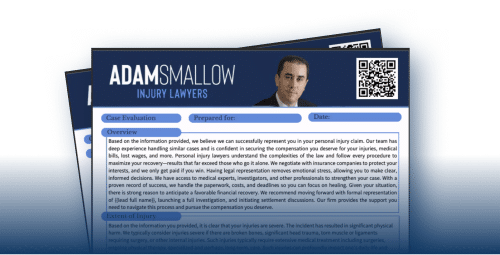
FREE Custom Case Evaluation
Want to know if you have a case? Use our FREE Case Evaluator to determine the strength of your claim